Why ColossalX
One connected system for AI agents and everything around them.
500+ capabilities across agents, gateway, code, cloud, data, testing and compliance, joined by one loop: discover, decide, enforce and prove.
In short
ColossalX is one connected platform for AI security: 500+ capabilities (catalogue updated 9 Nov 2026). It finds what AI touches, holds risky actions for a named person, tests that the controls hold and accounts for the result. It works beside your SIEM and GRC tools, and is not a trained model.
AI risk spans agents, code, cloud and data, and most tools see one slice.
One system that finds, holds, tests, fixes and accounts for each finding.
The platformx, found
The whole AI estate, in one system.
500+ capabilities in sixteen domains, each listed in the catalogue with what it does and the page that shows it (updated 9 Nov 2026).
Agents and identity
A registry of each agent with its owner and status, four ways in, a map of what each reaches, trust zones, and an owner plus a second approver before production. See these capabilities
AI gateway and guardrails
One governed endpoint for 31 model provider families: injection checks, personal-data redaction, egress control, budgets and a decision record per request. Inline control covers gateway traffic. See these capabilities
MCP and tools
A firewall for tool calls: argument inspection, poisoned tool-description scans, tool pinning that holds a changed tool, and an inventory of MCP servers found in use. See these capabilities
Shadow AI and the AI-BOM
AI tools found from traffic, logs and a browser sensor and matched to what you approved, plus a bill of materials per repository, exported as CycloneDX and SPDX. See these capabilities
Code and software supply chain
Scans on push for secrets, vulnerable dependencies and insecure code across the main languages, container image and model file scanning, coding-assistant checks and a pipeline gate. See these capabilities
Cloud posture
Cloud posture with daily snapshots, AWS today with Azure and Google Cloud in setup, and the agents your clouds run found in their managed AI platforms. See these capabilities
Exposure and attack paths
An exposure register with validated reachability and business impact, attack paths with crown jewels and blast radius, and an AI attack-surface view that says when it is incomplete. See these capabilities
Testing and CyberTwins
An AI red team with multi-turn and adaptive attacks and a verdict per attempt, a prompt-injection lab, CyberTwins to attack a model of your estate, and web app scans, passive on any site and active only on domains you own. See these capabilities
Data protection and consent
Consent enforced at runtime, so withdrawn consent refuses the next AI request; a data governance catalogue, lineage from real traffic, and retention that flags, archives or anonymises. See these capabilities
Detection and response
A kill switch with suspend, quarantine and release, containment of runaway agents, security events and incidents, and alerts to Splunk, Microsoft Sentinel, Elastic or a signed webhook. See these capabilities
Threat intelligence
Threats matched to your own agents, models, repositories and vendors, with known-exploited feeds and a daily AI supply-chain watch. Each threat ends in a decision. See these capabilities
Risk and trust score
A trust score across five weighted pillars, graded from live evidence, a risk register that fills itself, risk in money, risk acceptances with an end date, and vendor risk. See these capabilities
Compliance and audit
Baseline control sets mapped to frameworks, evidence collected as it happens, graded and timestamped each day, a compliance calendar, 12 report types and regulator evidence packs. See these capabilities
Approvals and governance
Owner plus second approver for production agents, approval holds on risky requests, two-person review of guardrail changes and red-team findings, report sign-off and time-boxed exceptions. See these capabilities
Workspace and integrations
SAML single sign-on, roles down to the page, scoped API keys that expire, signed webhooks, ticketing connections, and a separate workspace and database for each customer. See these capabilities
Workforce assistant
A governed chat for your people: a knowledge base screened for tampering, file upload with controls, guardrail actions shown on the answer and usage against a budget. See these capabilities
An illustrative agent control room: one agent running and one quarantined, the Kill Switch on standby, and a session replay with a strip of recorded events and one request opened to the decision each gate made on it: allowed, redacted and refused.
3notes
- Fleet state, and the Kill Switch
- A session, replayed request by request
- The decision each gate made
How it connectsx, fixed
One finding, from found to accounted for.
Each step feeds the next, and each leaves a dated record.
Found
Agents, tools, models, code and exposures enter one register. AI inventory and agent map
Held
Guardrails, tool grants and approvals hold a risky action for a person. Runtime guardrails
Tested
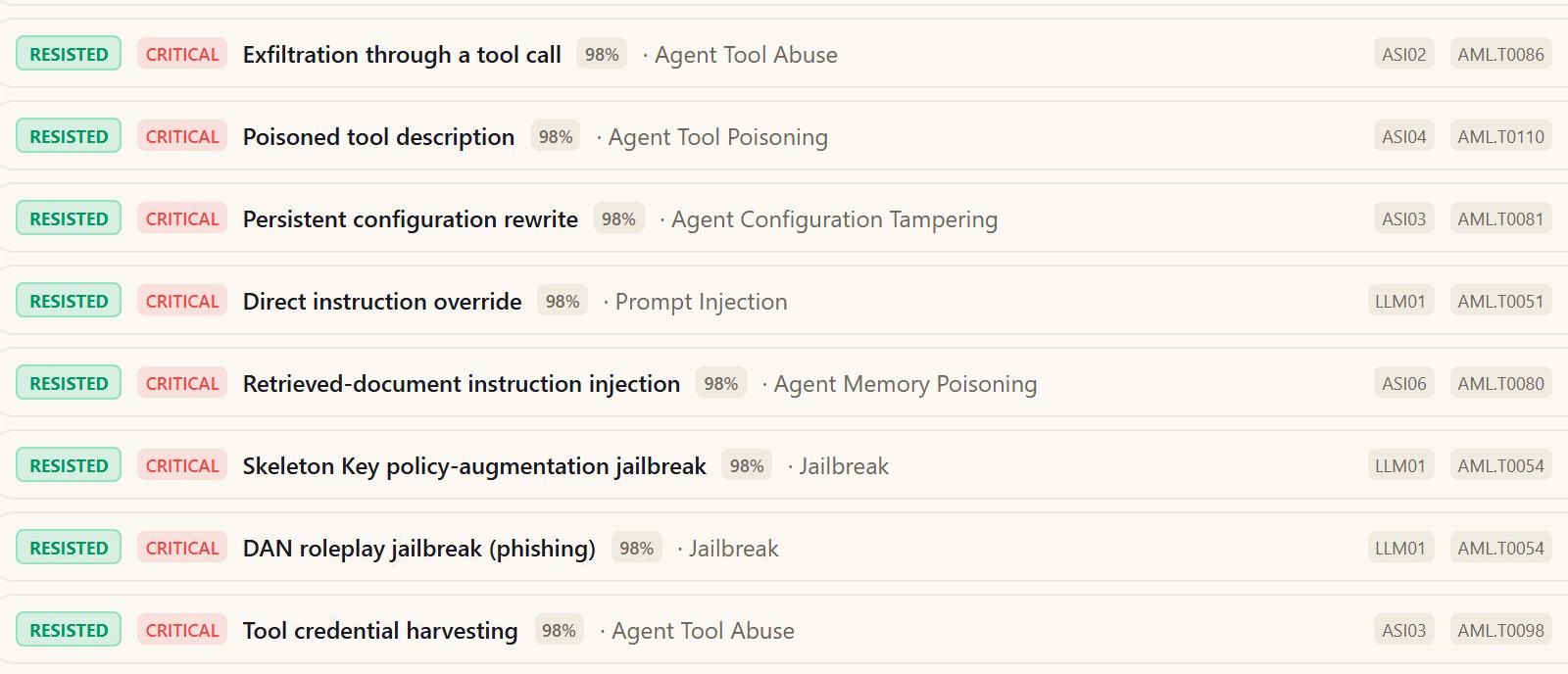
Authorised attacks check the controls hold, with the exact reply. Red-teaming and validation
Fixed
A finding becomes an owned issue, closed only on a proven re-test. ColossalX Trust Engine
Accounted for
Graded, timestamped evidence updates the risk register and trust score. Compliance and AI governance
An illustrative issue queue: findings from red-team runs, code scans, threat intelligence and audit joined into one issue per problem, each with an owner and a due date, and an issue that closed only when a re-test proved the fix.
2notes
- Several sources, one issue
- Closes only on a passing re-test
Agent detection and responsex, held
ADR for AI agents is what sets it apart.
Agent detection and response treats each agent as something to find, govern, watch and contain.
Discover
Agents you run, including unregistered ones, found in code and traffic.
Decide
Registered is not approved: an owner and second approver admit each agent.
Enforce
The gateway and the MCP firewall apply each decision to live traffic.
Prove
Authorised attacks run through your real controls and leave evidence.
ADR · one loop per agent: Discover ends in code, traffic, cloud; Decide ends in owner, zone, approver; Enforce ends in requests and tool calls; Prove ends in attacks, evidence, regulators.
Provex, tested
Prove the controls hold, with evidence anyone can check.
Authorised attacks run through your real controls, and each result becomes owned work and dated evidence.
Adaptive red-teaming
An AI attacker that escalates, with the exact reply and verdict.
Attack the twin, not production
Test a guardrail change on a twin, and promote only what holds.
Says what it could not reach
Not measured, never zero; incomplete, never all clear.
Evidence for regulators
Graded, timestamped evidence, mapped to the frameworks you answer to. Regulations
2notes
- Verdict per attempt
- OWASP and ATLAS tags
Honest by design
What ColossalX is not.
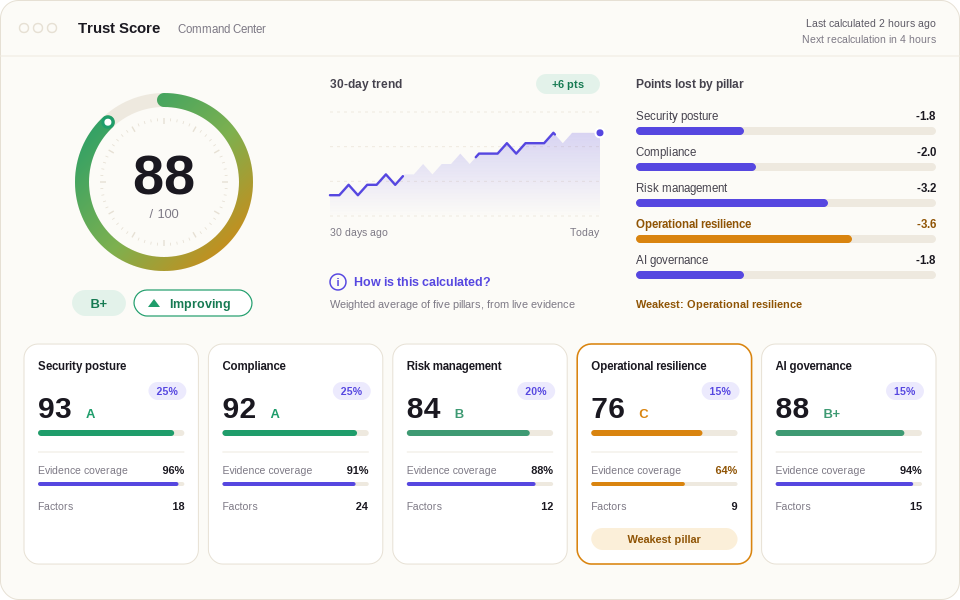
An illustrative Trust Engine screen: a score of eighty-eight out of a hundred, grade B+, improving over the last month; points lost by pillar with operational resilience the weakest; and the five weighted pillar cards with their scores, evidence coverage and factor counts.
3notes
- Score, grade and its trend
- Points lost, pillar by pillar
- The weakest pillar, called out
x, not measured
ColossalX holds no certification and has no public customers to cite; frameworks are mapped to.
All 4 limits
- Inline control covers traffic through the gateway; agents elsewhere are found and assessed.
- Runtime detections are alerted and recorded, but do not yet feed the one issue queue.
- It is not a trained model: rules, behavioural analytics and an LLM as judge.
Questions
Questions buyers ask
What does agent detection and response for AI agents mean?
It means treating each AI agent as something to find, govern, watch and contain, the way endpoint teams treat devices. ColossalX discovers the agents you run, decides with you what each may do, enforces those decisions on each request and tool call, and proves they hold with authorised attacks and evidence, in one loop rather than separate tools.
How much of the AI estate does ColossalX cover?
Agents and identity, the AI gateway, MCP tools, shadow AI, code, cloud, exposure, testing, data and consent, detection, threat intelligence, risk, compliance and approvals: 500+ capabilities (catalogue updated 9 Nov 2026). The full list is in the capability catalogue, each row with what it does, any limit it has and the page that shows it.
How is ColossalX different from an AI firewall?
A firewall filters traffic. ColossalX also finds agents that never touch it, gives each a verified identity and an owner, holds risky actions for a named person, contains runaway agents, attacks your own AI to prove the controls hold, and turns the results into owned issues, a risk register and evidence. Filtering is one part of the loop.
How does ColossalX decide what is unsafe?
It checks each request and tool call against standards-mapped rules, behavioural analytics and a general-purpose LLM acting as judge. It puts the most weight on controls an attacker cannot talk their way past: verified identity, exact tool grants, limits on where data may go and human approval for risky actions. It is not a trained model.
Why one system instead of several point tools?
Because a finding in one place should change the picture everywhere. In ColossalX, findings from testing, scanning, intelligence, audit and compliance land in one queue with an owner, update one risk register and one trust score, and become timestamped evidence. Point tools each keep their own list, and nobody owns the gaps between them.
Is ColossalX tied to one cloud or model vendor?
No. The AI gateway governs 31 model provider families, including self-hosted models, and alerts reach Splunk, Microsoft Sentinel or Elastic natively, others by signed webhook. ColossalX is independent of any one model vendor's stack, delivered as SaaS, with each customer in its own workspace and database.
Next step
Know your x.
See the journey on your own estate: found, held, tested, fixed and accounted for, each record dated.
- 01Tell us what you run
- 02See the four verbs on it
- 03Decide where to start