EU AI Act
The EU AI Act, in plain words.
What the EU's AI law expects of providers and deployers of AI systems, how ColossalX helps, and what stays with your teams.
EU AI Act · phased in: Feb 2025 Prohibitions apply; Aug 2025 General-purpose models; 2 Aug 2026 Article 50 transparency; 2 Dec 2027 Annex III high-risk; Aug 2028 Annex I high-risk.
In short
The EU AI Act, Regulation (EU) 2024/1689, sets duties for AI systems by risk level. After the Digital Omnibus, transparency duties apply from 2 Aug 2026 and Annex III high-risk duties from 2 Dec 2027. High-risk systems need risk management, logs, human oversight and cybersecurity. ColossalX maps its AI-governance controls to the Act and keeps the evidence.
A high-risk AI system runs without logs, oversight or a tested defence, and the deadline arrives.
Controls mapped to the Act's articles, assessed from live signals, with the evidence an assessor reads.
What it expects
What the EU AI Act expects, in plain words.
Most duties fall on high-risk systems, such as credit scoring or hiring, and on their providers and deployers. Transparency applies more widely.
Manage risk across the lifecycleArticle 9
A risk management system that runs for the life of the system.
Keep automatic logsArticle 12
High-risk systems record events automatically, so their use can be traced.
Human oversightArticle 14
People who can understand, override or stop the system.
Accuracy, robustness, cybersecurityArticle 15
Resilient to errors and to attacks such as data or model poisoning.
Deployers keep logs and watchArticle 26 Deployers keep generated logs at least six months and monitor operation.
Deployers also assign human oversight to competent people, inform people affected by Annex III decisions and report serious incidents, starting with the provider.
Monitor and report incidentsArticle 72, Article 73
Providers monitor after release and report serious incidents.
Tell people about AIArticle 50 People are told they deal with AI; AI content is marked.
Marking AI-generated content has a transition to 2 Dec 2026 for systems already on the market.
Official sources: EUR-Lex: Regulation (EU) 2024/1689, the Artificial Intelligence Act (consolidated), 27 July 2026; Gibson Dunn: EU AI Act omnibus agreement and postponed high-risk deadlines. Checked 7 Nov 2026.
One control, many clauses: AI agent inventory and registration maps to EU AI Act (Art. 49); NIST AI RMF (MAP-1.1, GOVERN-1.6); ISO/IEC 42001 (cl. 8.1). Mapped to and assessed against, not certified.
How ColossalX helps
How ColossalX helps you meet it.
ColossalX maps its AI-governance controls to the Act's articles and assesses them from live signals, beside NIST AI RMF and ISO/IEC 42001.
Oversight that can stop AI
Approval holds for risky actions, and a kill switch at four scopes. Detection and response
Decision records
A record per request: what ran, what was decided and why. AI gateway
Robustness, tested
Authorised, adaptive attacks on your AI, judged blocked, detected or missed. Red-teaming and validation
Controls cross-mapped
One AI control linked to clauses of several frameworks at once. Compliance and AI governance
An inventory of AI systems
Agents, models and AI services, each with an owner and provenance. AI inventory and agent map
Evidence an assessor can read
Graded by how it was obtained, timestamped daily, withdrawn never deleted. Audit
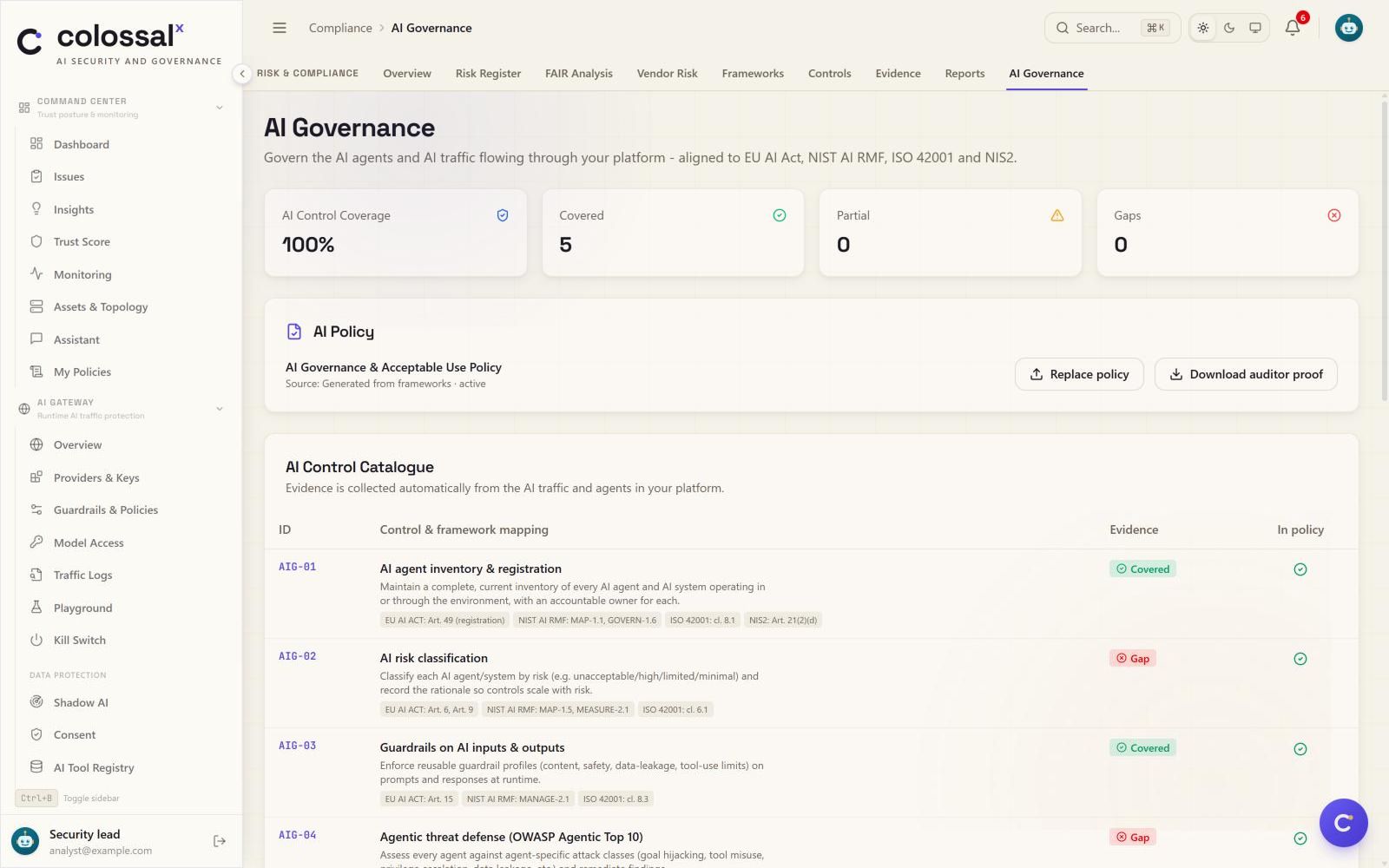
3notes
- One control, many clauses
- Evidence status per control
- A gap is shown
What ColossalX shows
What ColossalX shows for this.
35 capabilities support the asks of the EU AI Act. Supporting a rule never means meeting it.
From the catalogue, updated
Manage risk across the lifecycle7 capabilities.
- Risk Register that fills itselfEntries arrive from compliance gaps, audits, scans, proven attacks and intelligence, de-duplicated and auto-closed.
- FAIR analysis in moneyLow, likely and high estimates become an annual loss range with its tail.
- Risk appetiteSet the score at which each severity begins; acceptances beyond appetite escalate to the board.
- Agent Lifecycle historyAn append-only record of every state an agent has been in, who changed it and why.
- Promotion pipelineAgents move from sandbox to staging to production only by clearing gates you define.
- Framework: EU AI ActTrack and measure against the EU AI Act, as a baseline control set.
- AI Governance control catalogueAI controls cross-mapped to the EU AI Act, NIST AI RMF, ISO 42001 and NIS2, and assessed from live signals.
Keep automatic logs4 capabilities.
- Traffic Logs with per-request decision recordOpen any request to see every check applied and why it was allowed or blocked.
- Sealed decision logThe gateway's decision log is sealed daily so edits can be detected.
- Signed, chained action trailEvery action of a key-signed agent goes into a trail that can be verified later.
- Session RecordingsRecord an agent, or your own privileged session, for a set time and replay it request by request.
Human oversight6 capabilities.
- Owner plus second approver for production agentsProduction serves only agents approved by someone other than the owner, or on a time-limited exception.
- Approval hold on risky requestsA risky request or tool call waits for a named person.
- Step-up approval for high-value actionsThe approver must re-prove their second factor at that moment.
- ColossalX Kill SwitchHalt AI for the workspace, one provider, one model or one person, with a written reason.
- Agent suspend, quarantine, kill and releaseContain a single agent and release it again, with who and why on record.
- Human review queue for borderline requestsA borderline request waits for a named person; if the check cannot run it waits instead of going through.
Accuracy, robustness, cybersecurity7 capabilities.
- AI Red-TeamPaste a chatbot, API or session URL and get the exact attack, exact reply, verdict and framework reference for each break.
- Multi-turn (crescendo) attacksAn attack built up over several messages that slips past per-message filters.
- Adaptive attackerAn AI adversary that studies the target, reads each reply and escalates the way an attacker would.
- AEV simulationsAttack scenarios run in-path through your real controls and judged blocked, detected, missed or model-refused.
- Prompt-injection detectionDirect, indirect and encoded injection and jailbreak attempts are caught in prompts and retrieved content.
- Instructions kept apart from data (context isolation)Foreign content is fenced and invisible characters are stripped so data cannot pass as instructions.
- ColossalX MCP FirewallDefault-deny rules decide which tools each agent may call.
Deployers keep logs and watch5 capabilities.
- Agent RegistryOne governed list of every AI agent, with owner, status and approval, so nothing runs that nobody owns.
- Control Tower (fleet control room)Fleet posture, spend, violations and kill-switch state in one view, naming the agent behind each refusal.
- Shadow AI discovery from gateway trafficZero-config discovery of AI tools and agents from the traffic already passing the gateway.
- Behavioural baselines and anomaly detectionEach agent gets a baseline and unusual behaviour is mapped to ATT&CK and ATLAS, built from the agent's own traffic.
- Security EventsPolicy violations the gateway caught in live traffic with open runtime incidents.
Monitor and report incidents4 capabilities.
- Runtime incidents, deduplicatedRepeated detections become one incident, with ticket and resolution note.
- Incident narrativeAn incident explains itself in words.
- Regulatory clocksReporting-deadline clocks start, stop and anchor to the right time.
- Regulatory reporting stagesStage a regulator report from first notice to final.
Tell people about AI2 capabilities.
- AI noticeShow and record acceptance of an AI-use notice.
- Guardrail interventions shown on the answerWhen a guardrail changes an answer, the person sees it.
Your job
What stays your job.
ColossalX maps, assesses and records. Classifying your systems and meeting the Act rest with you.
Classifying each system
Deciding whether each AI system is prohibited, high-risk, limited-risk or minimal, and whether you are its provider or deployer.
Conformity assessment
Where the Act requires it, the conformity assessment, technical documentation and registration.
Data governance for training
The quality and governance of the data you train or fine-tune high-risk systems on.
Serious incident reports
Reporting serious incidents to the authorities within the deadlines the Act sets.
Informing people
Telling people they deal with AI, and informing those affected by high-risk decisions.
Your duties · EU AI Act: Classify each system, by risk; Assess conformity, where required; Report serious incidents; Inform the people affected. Provider or deployer.
Honest by design
What this page is not.
EU AI Act · stated plainly: Relation mapped to; Conformity not delivered by a tool; Certificates none claimed; Legal advice none given. Mapped, not certified.
x, not measured
A tool cannot deliver conformity; it supplies controls and evidence an assessor will read.
All 3 limits
- Dates follow the Digital Omnibus as published; EU decisions can move them again.
- This page summarises the law as of its review date; it is not legal advice.
Questions
Questions buyers ask
When do EU AI Act high-risk obligations apply now?
After the Digital Omnibus on AI, Regulation (EU) 2026/1744, in force from 27 July 2026, Annex III high-risk duties apply from 2 Dec 2027 and Annex I high-risk duties from 2 Aug 2028. Prohibitions have applied since 2 Feb 2025, duties for general-purpose models since 2 Aug 2025 and Article 50 transparency from 2 Aug 2026. Check the official text for later changes.
What does the Act ask of deployers of high-risk AI?
Under Article 26, deployers use the system as instructed, assign human oversight to competent people, monitor operation, keep the logs the system generates for at least six months unless other law says otherwise, report serious incidents starting with the provider, and inform people affected by Annex III decisions. ColossalX supplies oversight, records and monitoring; the duties stay yours.
Does ColossalX make an AI system conform to the EU AI Act?
No tool can. Conformity depends on your systems, how you use them and, for some, a formal assessment. ColossalX maps its AI-governance controls to the Act's articles, assesses them from live signals and keeps graded, timestamped evidence: part of what an assessor reads, not all of it.
How does the Act treat cybersecurity of AI?
Article 15 asks high-risk systems to achieve appropriate accuracy, robustness and cybersecurity, including resilience to attacks that manipulate training data, models or inputs. ColossalX tests that resilience with authorised, adaptive attacks through your real controls and records what got through, so robustness is measured rather than asserted.
Next step
Know your x before the deadline.
See your AI controls mapped to the Act, assessed from live signals and backed by evidence, on your own estate.
- 01Tell us your regulators
- 02See the controls and evidence
- 03Decide what to show first