SolutionsFor AI governance and DPOs

For AI governance and DPOs: govern AI with evidence.

Know which personal data reaches which model, refuse AI requests once consent is withdrawn, and show who accepted which policy version.

AI policy · version recordIllustrative

AI policy · version record: Policy AI acceptable use, version 3; Text hash Recorded when published; Accepted by Named people, per version; Proof pack Ready for the auditor. Versioned, not filed.

In short

AI governance for DPOs, in ColossalX, means a current inventory of the AI the company runs, data lineage showing which personal data reached which model, consent checked when each AI request is made, policies accepted per version by named people, and AI-governance controls assessed from live signals and cross-mapped to the EU AI Act, NIST AI RMF and ISO/IEC 42001.

Last reviewed

The question you are asked

What personal data reaches which model, and under whose consent?

For AI governance and DPOs

Your committee's questions, and what answers them.

  1. Nobody can say which personal data reached which model.

    The controlLineage from gateway traffic: which agent sent which personal data to which model.

  2. Consent is withdrawn, and an AI system keeps using the data.

    The controlThe next AI request carrying that data is refused, and the refusal logged.

  3. The AI policy is a PDF nobody can prove was accepted.

    The controlEach version carries a hash of its text and its named acceptances.

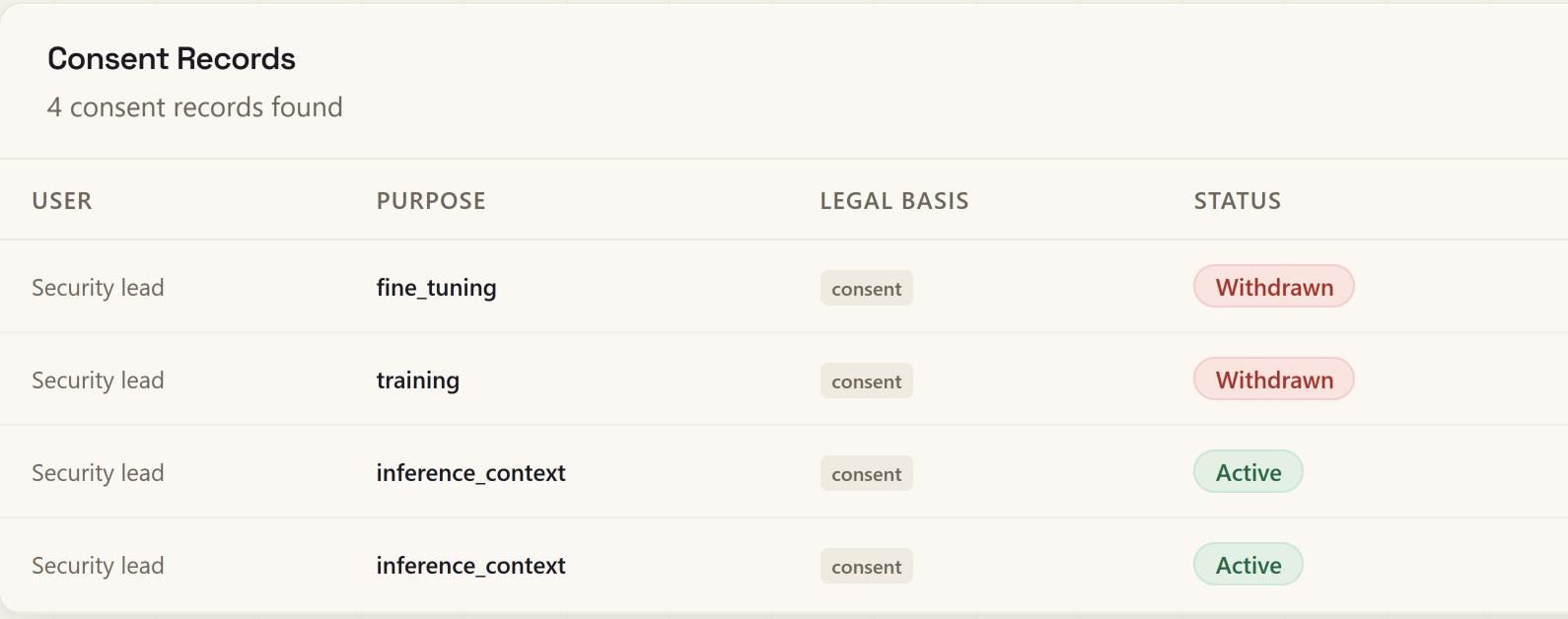
Consent records in a demo workspace: one record per AI purpose for each person, with the legal basis beside it; training and fine-tuning consent shows as withdrawn while the inference purpose stays active.
From a demo workspace
3notes
  1. One record per purpose
  2. Withdrawal stays recorded
  3. Inference purpose still active

The board

Questions the board will ask about AI use.

Do we know which AI uses personal data?

One inventory of models, agents and AI vendors, with lineage from real gateway traffic.

Can we show our AI honours consent?

Withdrawn consent refuses the next AI request carrying that data, with a log of refusals.

Who approved our AI policy, and who accepted it?

Each version is published with a hash of its text and named acceptances.

One control · four frameworksIllustrative

One control · four frameworks: AI agent inventory and registration maps to EU AI Act (Art. 49); NIST AI RMF (MAP-1.1, GOVERN-1.6); ISO/IEC 42001 (Clause 8.1); NIS2 (Art. 21(2)(d)). Mapped to and assessed against, not certified.

ColossalX

One-page brief · For AI governance and DPOs

AI governance, run on evidence

ColossalX, from Quantexra Labs, is an AI security and governance platform delivered as SaaS. It inventories your AI, checks consent at each request and keeps policy records.

Read the full brief

What it does

  • Data lineage from real gateway traffic.
  • Consent checked when each AI request is made.
  • Policies versioned, hashed and accepted by name.

Ask any vendor

  1. Which personal data reached which model last month?
  2. What happens to the next request after withdrawal?
  3. Can you show who accepted this policy version?

LimitRuntime consent covers signed-in users' inference requests, and fails open on error.

https://colossalx.tech/solutions/ai-governanceclient.success@quantexra.techSaaS, each customer in its own workspace and databaseWritten for an AI governance lead or DPO · last reviewed 6 Oct 2026

Honest by design

What we will not tell you.

Runtime consent · a check that failedIllustrative

Runtime consent · a check that failed: hr-assistant to outside model · inference, "Summarise the leave history for this employee". Checks: Prompt injection passed, Consent check unavailable flagged. Verdict: allowed, Consent check failed open.

x, not measured

Runtime consent covers the inference-context purpose for signed-in users, and fails open on error.

All 4 limits
  • Lineage is drawn from traffic through the AI gateway; calls that go around it are not in it.
  • Jurisdiction-pack content is a starting point for your counsel to review, not legal advice.
  • ColossalX holds no certification; frameworks are mapped to and assessed against.

Questions

Questions buyers ask

What does an AI governance committee do?

An AI governance committee sets the rules for how the company uses AI and checks that they are followed: it approves the AI policy, keeps an inventory of AI systems with owners, reviews assessments such as DPIAs and decides exceptions. ColossalX gives it the inventory, policy acceptance by version, controls assessed from live signals and a record of who decided and why.

How do you run a DPIA for an AI system?

Describe the processing, the personal data and the purpose, assess the risks to people and record the measures that reduce them. ColossalX keeps PIA, DPIA and TIA records and records of processing beside the AI inventory, and data lineage from real gateway traffic shows which personal data an agent actually sends, so the assessment matches what runs.

How do we know employees accepted the current AI policy?

Publish the policy in ColossalX and each version carries a hash of its text. People accept it per version in My Policies, so you can show who accepted which version, and an auditor proof pack collects the record. Because acceptance is recorded per version, a new version needs its own acceptance.

How does consent apply to AI processing?

Where AI processing relies on consent, as it often does under India's DPDP Act, the purpose must match what the person agreed to and a withdrawal must be honoured. ColossalX records consent across 11 AI purposes and checks it when the AI request is made: after withdrawal, the next request carrying that person's data is refused and logged.

Next step

Know your x before an auditor asks.

See ColossalX on your questions: which personal data reaches which model, under whose consent, and who accepted the policy.

  1. 01Tell us what you run
  2. 02See the four verbs on it
  3. 03Decide where to start