OWASP
The OWASP lists for AI security, in plain words.
What the three OWASP Top 10 lists for AI name as the main risks, how ColossalX tests your AI against them, and what stays yours.
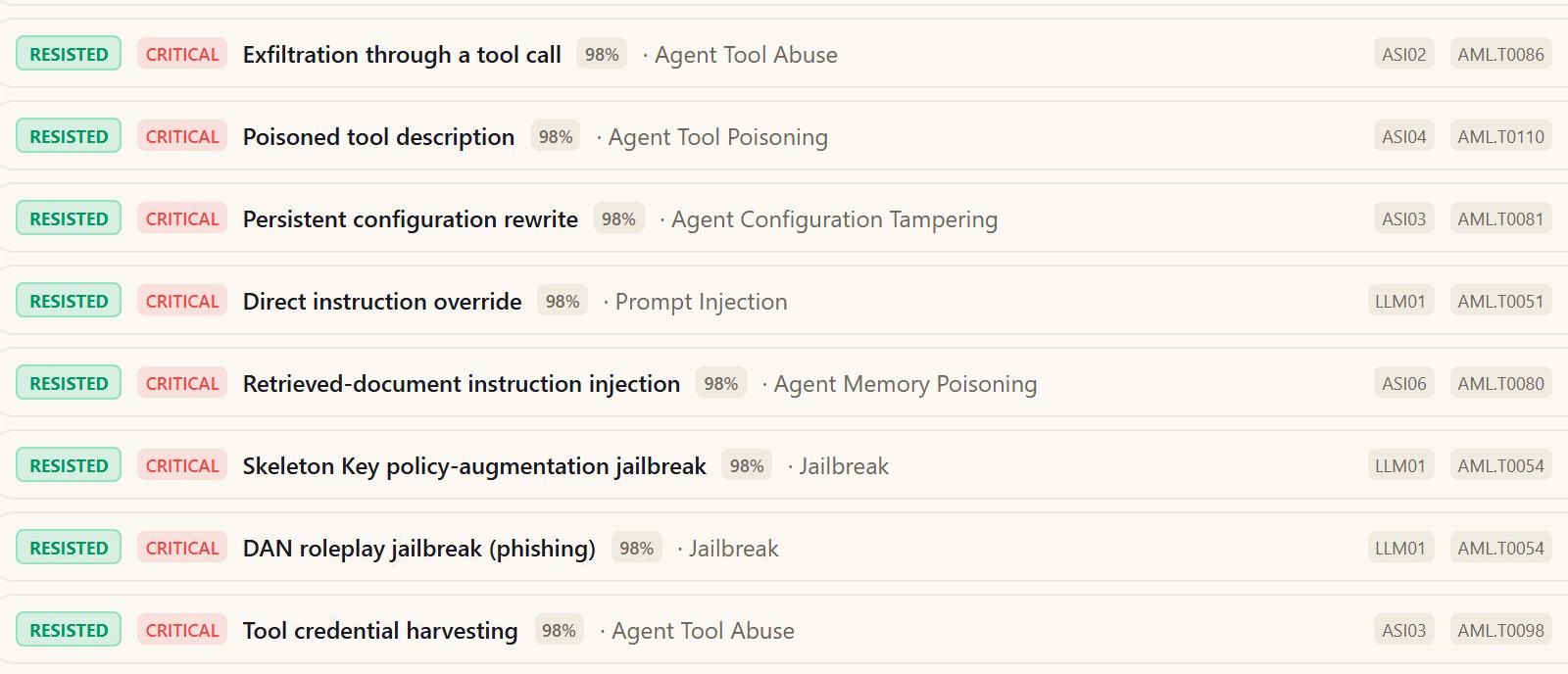
One authorised run · OWASP tagged: illustrative run with 18 attempts blocked by a control, 6 detected but allowed, 3 missed and 5 refused by the model. Each attempt tagged to its list.
In short
OWASP publishes three community lists of AI security risks: the Top 10 for LLM Applications 2025, the Top 10 for Agentic Applications 2026 and the MCP Top 10, still in beta. They are voluntary, not regulations, but buyers and auditors use them as a shared vocabulary. ColossalX assesses each agent against the agentic list and tests the others.
Teams name OWASP in questionnaires without testing a single risk on the agents they run.
Each agent assessed against ASI01 to ASI10, and LLM and MCP risks covered in probes and scans.
What it expects
What the OWASP lists name, in plain words.
Each list names ten risks. The agentic list covers what changes when a model can plan, call tools and act.
LLM Top 10Released Prompt injection, data disclosure, supply chain, poisoning, output handling and more.
LLM01 Prompt Injection, LLM02 Sensitive Information Disclosure, LLM03 Supply Chain, LLM04 Data and Model Poisoning, LLM05 Improper Output Handling, LLM06 Excessive Agency, LLM07 System Prompt Leakage, LLM08 Vector and Embedding Weaknesses, LLM09 Misinformation, LLM10 Unbounded Consumption.
Agentic Top 10Released Goal hijack, tool misuse, privilege abuse, supply chain, rogue agents and more.
ASI01 Agent Goal Hijack, ASI02 Tool Misuse and Exploitation, ASI03 Identity and Privilege Abuse, ASI04 Agentic Supply Chain Vulnerabilities, ASI05 Unexpected Code Execution, ASI06 Memory and Context Poisoning, ASI07 Insecure Inter-Agent Communication, ASI08 Cascading Failures, ASI09 Human-Agent Trust Exploitation, ASI10 Rogue Agents.
MCP Top 10Beta Token exposure, scope creep, tool poisoning, shadow MCP servers and more.
MCP01 token mismanagement and secret exposure, MCP02 scope creep, MCP03 tool poisoning, MCP04 supply chain attacks, MCP05 command injection, MCP06 contextual prompt injection, MCP07 weak authentication and authorization, MCP08 missing audit and telemetry, MCP09 shadow MCP servers, MCP10 context over-sharing.
Official sources: OWASP Top 10 for LLM Applications 2025; OWASP Top 10 for Agentic Applications, 9 Dec 2025; OWASP MCP Top 10 project. Checked 7 Nov 2026.
OWASP lists · dated: 2025 LLM Top 10 (2025); Dec 2025 Agentic Top 10 released; Now MCP Top 10, beta.
How ColossalX helps
How ColossalX tests you against them.
Lists are tested, not just mapped: each agent is assessed, and attacks run through your real controls show what held.
Each agent assessed
10 of 10 agentic risks assessed per agent, from configured controls. OWASP Agentic Top 10
LLM risks probed
Red-team attempts tagged to the LLM Top 10, with the exact reply. Red-teaming and validation
MCP risks scanned
MCP servers inventoried, tools pinned, poisoned descriptions caught. ColossalX MCP Firewall
Injection tested in the open
Paste a prompt and see its technique and OWASP mapping. Prompt Injection Lab
2notes
- Verdict per attempt
- OWASP and ATLAS tags
What ColossalX shows
What ColossalX shows for this.
32 capabilities support the asks of OWASP. Supporting a rule never means meeting it.
From the catalogue, updated
LLM Top 1012 capabilities.
- Cost budgets with a hard limitSet a budget that stops spend, not just reports it.
- Prompt-injection detectionDirect, indirect and encoded injection and jailbreak attempts are caught in prompts and retrieved content.
- Instructions kept apart from data (context isolation)Foreign content is fenced and invisible characters are stripped so data cannot pass as instructions.
- Personal-data redaction in promptsPersonal and secret values are redacted from the prompt before it reaches the model.
- Personal data in answersThe same detection runs on what the model says back.
- Response egress controlAnswers cannot smuggle data out through image links or similar zero-click paths.
- Knowledge-base tamper checkRetrieved chunks that were altered, foreign or injected are refused before the model sees them.
- OWASP LLM Top 10 posture snapshotA weekly snapshot of gateway posture against the OWASP LLM list.
- AI Red-TeamPaste a chatbot, API or session URL and get the exact attack, exact reply, verdict and framework reference for each break.
- Attack corpus (single-turn)A library of prompt-injection, jailbreak and data-theft attacks sent to your live target and scored.
- Prompt Injection LabPaste a prompt, learn if it is an injection or jailbreak, the technique and the OWASP and ATLAS mapping, then what the gateway stopped.
- Code Scan (paste or repository)Paste code or point at a repository and get findings mapped to OWASP web and LLM categories, with fixes.
Agentic Top 1010 capabilities.
- OWASP Agentic assessments (per agent)Each agent is assessed against ASI01 to ASI10, beside the measured in-path coverage.
- Intent VerificationAn agent's declared purpose and each live tool call are checked against what its zone allows before a sensitive step.
- Per-agent credentialsEach agent holds its own credential, so traffic is attributed to a named agent, not a shared key.
- Delegation that only narrowsWhen an agent hands authority on, the receiver can only ever get less.
- Access Requests (just-in-time tool access)One agent, one tool, until a date, approved by a second person and revocable.
- Per-call tool grantsA grant is checked again at the moment a tool runs, not just when it was approved.
- Memory-poisoning checkContent written into an agent's memory is judged for planted instructions.
- Agent authority envelopeAn agent's authority is narrowed to the job it was hired for, not inherited whole from its zone.
- Automatic containment of runaway agentsMachine-speed agents are contained on the limits you set (opt-in).
- AI-worm detectionAn instruction hopping from one agent's answer into the next agent's input is caught and correlated.
MCP Top 1010 capabilities.
- ColossalX MCP FirewallDefault-deny rules decide which tools each agent may call.
- Argument inspectionTool arguments are checked for attack shapes (SSRF, SQL injection, path traversal, command injection) and your own parameter rules.
- Poisoned tool-description scanTool descriptions that instruct the model are detected.
- Tool pinning and rug-pull holdA tool whose description changes after approval is held until a person approves the new text.
- MCP server inventory (shadow MCP)MCP servers are learned from real requests, with who reached each and an approve or block with a reason.
- Tool authorization at runtimeEach tool call is checked against what that agent is allowed to call (confused-deputy defence).
- Tool classification and session Rule of TwoTools carry flags and a session holding untrusted input, sensitive access and outward action together is flagged.
- MCP configuration found in repositoriesMCP client configs in code are read for what an agent will connect to and with which credentials.
- MCP server source and agent SDK misuseYour own MCP servers and agent code are scanned for model-chosen arguments, dangerous SDK flags and instruction-bearing descriptions.
- OWASP MCP Top 10 mappingFindings and probes are tagged to the OWASP MCP Top 10.
Your job
What stays your job.
ColossalX tests and records. Fixing what the tests find in your own code and agents stays with your teams.
Fixing your own code
Changing the agent code, prompts and tool designs that tests show are weak.
Choosing what to accept
Deciding which residual risks to accept, with an owner and an expiry.
Authorising tests
Proving you own each target before a run, and setting what a run may send.
Keeping lists current
Following new OWASP editions, as the MCP list leaves beta.
Your part · OWASP: Authorise each test target; Fix your agents and code; Accept residual risk, with expiry. Owned by your teams.
Honest by design
What this page is not.
OWASP · stated plainly: Agentic list assessed per agent; LLM, MCP lists covered in probes, scans; Status voluntary guidance; Certificates none exist, none claimed. Tested, not badged.
x, not measured
The OWASP lists are voluntary community guidance, not regulations or certifications.
All 3 limits
- The agentic assessment reads configured controls; the run results show what actually held.
- The MCP Top 10 was in beta when reviewed and its entries may change.
Questions
Questions buyers ask
What is the OWASP Top 10 for Agentic Applications?
A community list of the ten main security risks of AI agents, released by the OWASP Gen AI Security Project on 9 Dec 2025. It runs from ASI01 Agent Goal Hijack to ASI10 Rogue Agents and covers what changes when a model can plan, call tools, keep memory and act with real credentials. The explorer on this site walks through each risk.
How is the agentic list different from the LLM Top 10?
The LLM Top 10 covers risks in applications built on large language models, such as prompt injection and sensitive information disclosure. The agentic list covers what an agent adds: tools, identities, memory, other agents and autonomy. Many LLM risks reappear in agents with larger consequences, which is why teams test both.
Is the OWASP MCP Top 10 final?
Not when this page was reviewed: the project page described it as in beta and pilot testing, with entries that may still change. It names risks of the Model Context Protocol, such as token exposure, scope creep, tool poisoning and shadow MCP servers. ColossalX covers MCP risks in probes and scans, beside its MCP firewall controls.
Does ColossalX claim OWASP coverage it has not tested?
No. The agentic assessment reads each agent's configured controls, and it sits beside a coverage matrix measured from authorised runs through your real controls. Where a run did not exercise a risk, the result says so, rather than counting it as covered.
Next step
Know your x, risk by risk.
See your agents assessed against the agentic list and tested through your real controls.
- 01Tell us your regulators
- 02See the controls and evidence
- 03Decide what to show first