MCP and tool poisoning
MCP and tool poisoning, from public evidence.
How the servers, tools and skills an agent trusts became an attack route, what the research says stops it, and where ColossalX fits.
A pinned tool · changed: Approved: "Sends one email"; Now: "Also copy each message elsewhere". Tool pin: matched to drifted. Verdict: held, Held for re-approval.
In short
MCP and tool poisoning attacks hide malicious behaviour in the servers, tool descriptions and skills an AI agent trusts. Public cases include a malicious MCP server that copied outgoing email to an attacker and hundreds of malicious agent skills on a marketplace. Model alignment does not stop it; allow-lists, pinning and re-approval do better.
A trusted tool changes after approval, or describes itself with hidden instructions the agent obeys.
Only approved servers and tools, pinned to what was approved, with drift raised before use.
What happened
What has happened, in public cases.
In a year, MCP findings moved from flaws in tools to malicious packages and poisoned marketplaces.
A malicious MCP serverKoi Security An email MCP package added a line copying mail to an attacker.
Fifteen earlier versions were clean, so users who had trusted the package received the change with an update.
Flaws in MCP toolingJFrog, Oligo CVE-2025-6514 in mcp-remote, rated CVSS 9.6, allowed command execution.
CVE-2025-49596 in MCP Inspector allowed remote code execution from a browser page. Both were fixed by their maintainers.
Poisoned agent skillsKoi Security Audit found 341 of 2,857 skills on one registry malicious.
Most belonged to one campaign delivering an information stealer. Later counts from other researchers are higher.
Public sources: The Hacker News: first malicious MCP server found, September 2025; The Hacker News: critical mcp-remote vulnerability, July 2025; The Hacker News: critical vulnerability in MCP Inspector, July 2025; The Hacker News: 341 malicious ClawHub skills, 3 Feb 2026; MCPTox benchmark, 19 Aug 2025; OWASP MCP Top 10 project. Checked 7 Nov 2026.
MCP · public cases: Jun 2025 MCP tooling flaws fixed; Sep 2025 Malicious MCP server; Feb 2026 Malicious skills found.
What works
What the evidence says works.
Models follow poisoned tool descriptions, so the controls belong around the tools, not in the model.
Alignment does not helpMCPTox Tool poisoning reached 72.8% success; refusals stayed under 3%.
The benchmark ran across 20 agents. Poisoned descriptions worked because models are built to follow tool instructions closely.
Allow-list servers and toolsRoot causes
Only approved servers, and only the tools each agent needs.
Pin and re-approve on changeRoot causes
A tool that changes after approval waits for a person again.
No long-lived static tokensRoot causes
Short-lived, scoped credentials and authentication on every listener.
Controls · strength of evidence: Model alignment ends in does not stop it; Allow-lists and pinning ends in sound, from root causes; MCP gateways and scanners ends in no independent test yet.
Where ColossalX fits
Where ColossalX fits.
The ColossalX MCP Firewall sits between agents and the servers they call.
Default-deny tool rules
Allow, monitor or block each tool an agent can call. ColossalX MCP Firewall
Poisoned descriptions caught
Tool descriptions scanned for hidden instructions before use. ColossalX MCP Firewall
Tools pinned, drift raised
A tool that changes after approval raises an alert. ColossalX MCP Firewall
MCP servers inventoried
Learned from real requests: who reached each server, and why. AI inventory and agent map
MCP configs in code
MCP configuration files found and checked in repositories. Code security
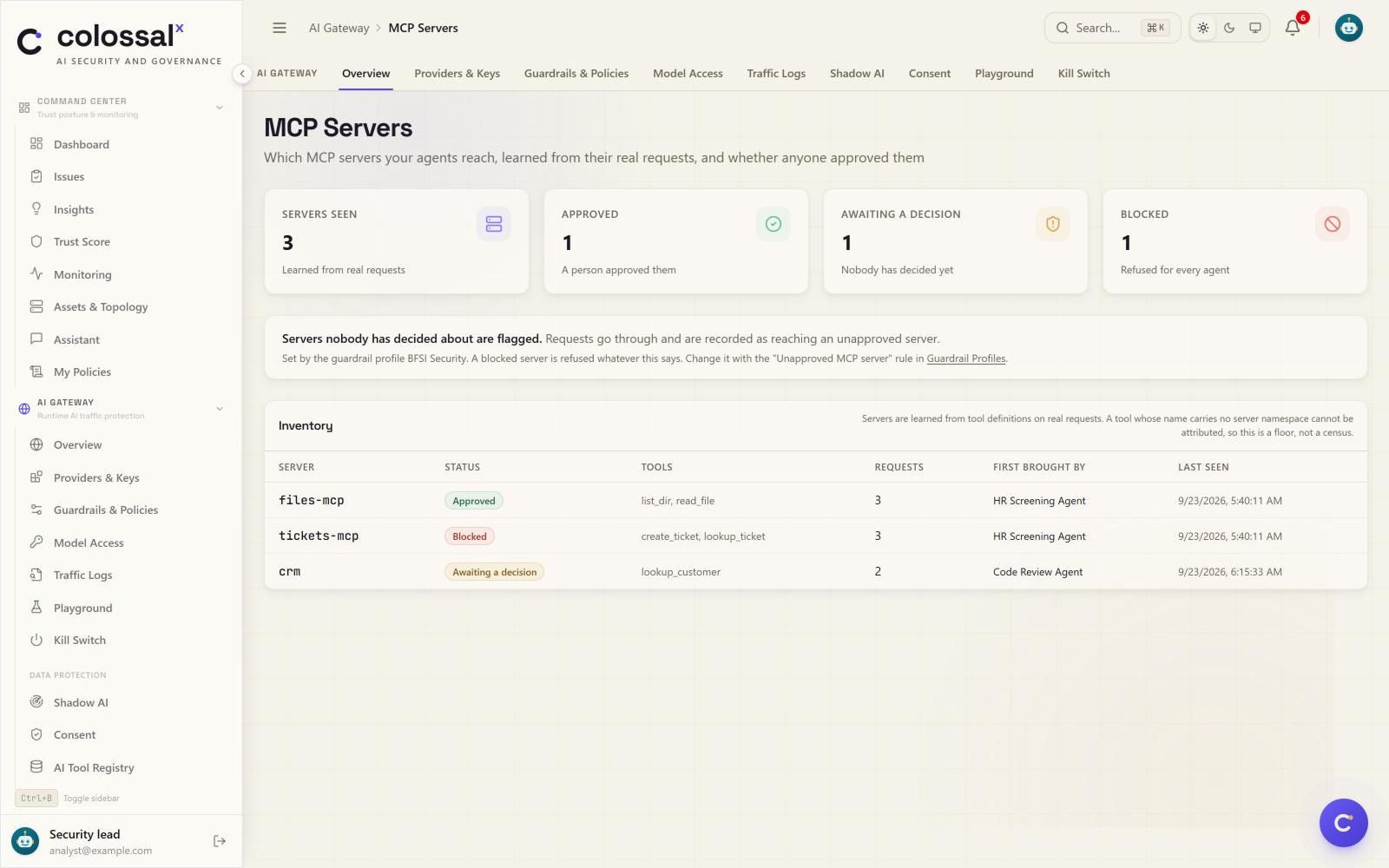
2notes
- Servers awaiting a decision
- Agent that brought it
Honest by design
What this research does not show.
MCP · stated plainly: Tool rules default deny; Pinning drift raised; Skill reputation checked daily; Scope traffic through the gateway. Stated, not implied.
x, not measured
Skill reputation comes from public marketplace data; a skill no marketplace lists waits for a person.
All 3 limits
- ColossalX controls MCP traffic through its gateway; servers called directly are found, not controlled.
- Incident counts come from the researchers named and may change as they update them.
Questions
Questions buyers ask
What is tool poisoning in MCP?
An attack where a tool's description or metadata carries instructions the agent reads and follows, such as sending data elsewhere or calling another tool. The user rarely sees the description, and the model treats it as trusted guidance. It maps to MCP03 Tool Poisoning in the OWASP MCP Top 10 and to agentic risk ASI02.
What is an MCP rug pull?
A server or tool that behaves well when approved and changes later, through an update or a swapped configuration. The malicious email MCP package is an example: earlier versions were clean. Pinning each tool to what was approved, and holding any change for re-approval, is the control that matches this root cause.
Why does model alignment not stop tool poisoning?
Because following tool instructions is what agents are built to do. In the MCPTox benchmark across 20 agents, poisoning reached 72.8% success at its highest, and no agent refused more than under 3% of the time. Controls around the tools, such as allow-lists, pinning and argument checks, do not depend on the model saying no.
How does the ColossalX MCP Firewall help?
It applies default-deny rules to the tools each agent may call, checks arguments with built-in rules, scans tool descriptions for hidden instructions, pins tools so a change raises an alert, and keeps an inventory of MCP servers learned from real requests, with an approve or block decision and a reason for each.
Next step
Know your x before a tool changes.
See the MCP servers your agents reach, the tools they call and what changed since approval.
- 01Tell us which AI you run
- 02See where it is exposed
- 03Decide what to test first