AI supply chain
The AI supply chain under attack, from public evidence.
How poisoned packages and unsafe model files reached AI teams, what the evidence says stops them, and where ColossalX fits.
A build · checked: llm-client update to ColossalX; model file to ColossalX; ColossalX refused before build (known malicious).
In short
The AI supply chain is the packages, models and tools an AI system is built from, and attackers now poison it directly. Public cases include a self-spreading npm worm, malicious releases of a popular AI gateway library and model files that ran code when loaded. Safe model formats, pinning and provenance matter most.
A dependency or model file you trust runs the attacker's code the moment it is installed or loaded.
Each package and model checked against known-malicious lists and unsafe formats before it runs.
What happened
What has happened, in public cases.
Attackers went for the packages AI teams install every day and for the files models ship in.
A self-spreading npm wormShai-Hulud 2.0 Wiz counted 25,000+ affected GitHub repositories.
The worm stole publishing tokens and used them to release poisoned versions of more packages.
Malicious AI library releasesLiteLLM Two releases of a widely used AI gateway library carried malware.
The maintainers say the releases were live on PyPI for a window of hours on one day in March, and that their official container image was not affected.
Model files that run codeReversingLabs Malicious pickle model files evaded a model hub's scanner.
Pickle files can execute code when loaded, and scanners that look for known bad patterns can be bypassed.
Public sources: Wiz Research: Shai-Hulud 2.0, 24 Nov 2025; LiteLLM: security update, 24 March 2026; Infosecurity Magazine: malicious AI models on Hugging Face, February 2025; OpenSSF malicious packages. Checked 7 Nov 2026.
Supply chain · public cases: Feb 2025 Pickle scanner evaded; Nov 2025 Shai-Hulud 2.0; Mar 2026 AI library releases poisoned.
What works
What the evidence says works.
Safe formats remove a whole class of attack by design. Scanners help, but only as a supplement.
Safe model formatsBy design
Formats such as safetensors cannot run code when loaded.
Scanning as a supplementBypassable
Pattern-based model scanners miss what they have not seen.
Pin, mirror and verifyRoot causes
Pin versions and hashes, and install from an internal mirror.
An AI bill of materialsGuidance
Know which models and AI libraries each system contains.
Controls · strength of evidence: Safe model formats ends in strong, by design; Model and package scanners ends in bypassable supplement; Pinning and provenance ends in sound, not yet measured.
Where ColossalX fits
Where ColossalX fits.
ColossalX checks the packages, models and images your AI systems are built from.
Known-malicious packages
Dependencies checked against the OpenSSF malicious-packages list; a match is critical. Code security
Reachability, not just presence
Whether vulnerable code is actually called, ranked with exploit signals. Code security
Unsafe model files flagged
Unsafe formats, remote-code loading and loader scripts, inspected, never executed. Code security
An AI-BOM per system
AI components apart from ordinary libraries, with baselines and drift. AI bill of materials
Container images scanned
Images scanned for vulnerable packages, alongside the code. Code security
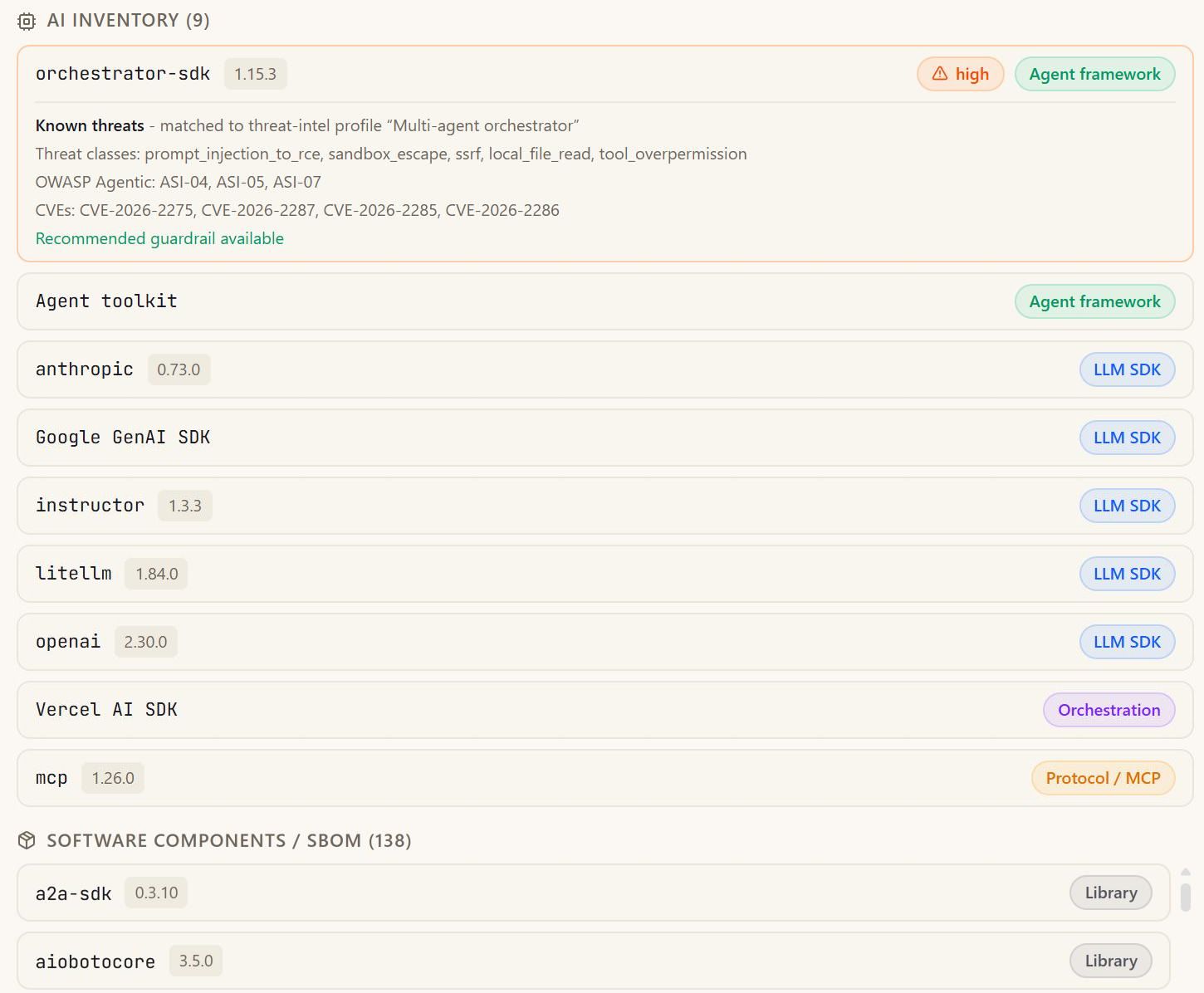
2notes
- AI parts, listed apart
- Libraries, listed below
Honest by design
What this research does not show.
Supply chain · stated plainly: Malicious packages checked against OpenSSF; Model files inspected, never run; Model signatures checked offline. Stated, not implied.
x, not measured
Model signatures are checked offline against a trust root you set, and only where the publisher signed.
All 3 limits
- Model file inspection flags unsafe formats and loaders; like any scanner, it can miss new tricks.
- Incident details come from the maintainers and researchers named, and may be incomplete.
Questions
Questions buyers ask
Why are pickle model files risky?
The pickle format can execute code while a file is loaded, so a model shared as a pickle can run an attacker's code on the machine that opens it. Researchers have shown malicious pickles evading a model hub's scanner. Formats such as safetensors store weights without executable code, which removes the risk by design.
What happened to the LiteLLM package?
In March 2026, two malicious releases of LiteLLM, a widely used library for calling AI models, were published to PyPI. The maintainers say the releases were live for a window of hours that day, that the official container image was unaffected, and that a clean release followed. Teams that pinned versions or installed from a mirror were protected.
Has slopsquatting been seen in the wild?
Slopsquatting means registering package names that AI assistants invent, so code written with AI pulls in the attacker's package. It has been shown in research, but the briefing behind this page found no verified incident in the wild. Checking new dependencies against known-malicious lists and pinning versions covers it either way.
How does ColossalX check the AI supply chain?
Each dependency is checked against the OpenSSF malicious-packages list, where a match is critical, and against known-exploited vulnerabilities, with reachability showing whether vulnerable code is actually called. Model files are inspected, never executed, for unsafe formats, remote-code loading and loader scripts, and each system gets an AI-BOM with drift against an approved baseline.
Next step
Know your x before it installs.
See the packages, models and images your AI systems are built from, checked and on one bill of materials.
- 01Tell us which AI you run
- 02See where it is exposed
- 03Decide what to test first